No profession in Singapore burns through name cards like real estate. Every viewing, every roadshow booth at the mall, every referral lunch — and every card you hand out is out of date the moment you close the listing printed on it, or the moment you move from one agency to another. Property agents were the first profession here to go all-in on digital cards, and it was never a gimmick: the job is literally meeting strangers all day and being the one they remember six months later, when they're finally ready to buy or sell. Here's how the digital version changes the maths — and the specifics that actually matter for a CEA-registered agent in Singapore.
Why real estate is the hardest test for a paper card
Think about how quickly an agent's details go stale, and how little control paper gives you over it:
Paper is a broadcast that decays. A digital card is a single living link: you update it once, and everyone who ever saved it always sees the current version. For a profession where being remembered later is the entire business model, that difference compounds.
What a buyer actually sees when they tap your card
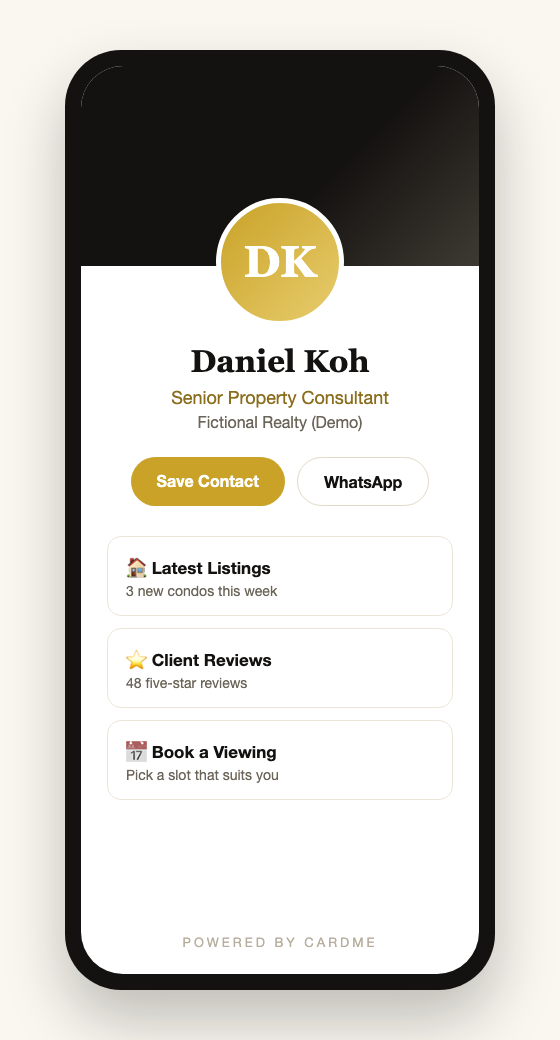
One tap on your NFC card, or one scan of your QR code, and the prospect lands on a single clean mobile page with everything they need to act on:
The CEA number problem digital quietly solves
Every practising property agent in Singapore must display their CEA registration number, and buyers increasingly check it on the CEA Public Register before dealing with anyone. On paper, that number is one more thing to reprint if your details ever change, and a hand-corrected or "temporary" card instantly looks dodgy to a cautious client. On a digital card, your CEA number lives on your profile as part of your details — always shown, always correct — so a careful buyer can verify you in seconds and feels safer for it. In property, trust is the product. Anything that makes you easier to verify is quietly doing sales work for you.
The habits that compound
QR on your lock screen. At a viewing your hands are full of keys, brochures and a phone. Flip the phone around, the buyer scans, done — no fumbling for a card that's in your other bag. (Our five-minute setup guide walks through it.)
QR on every printed surface. Flyers, show-flat standees, bus-stop ads, car decals, the back of your closing gift — every printed thing you own becomes a way to capture a lead, not just broadcast a phone number into the void.
Capture, don't just share. Networking cuts both ways. When a prospect hands you a paper card or rattles off their details, they go into your phone — and the serious platforms will scan received cards with AI straight into your contacts or CRM, so the follow-up actually happens the same evening instead of never.
One link, everywhere. Instagram bio, TikTok, WhatsApp status, email signature, your PropertyGuru profile — the same card link, always current. Change agencies and you update one profile, not eleven bios.
Turn every marketing dollar into a lead, not just a impression
Agents already spend on marketing — portal listings, mailbox drops, roadshow booths, sponsored posts. The problem with most of it is that it broadcasts and hopes. Put your card's QR on all of it and each surface gains a direct response: the mailbox flyer that would've been recycled now has a scannable path to your WhatsApp; the roadshow standee captures the couple who were "just looking" but scanned to keep your details; the sponsored post drives to a card that saves to contacts in one tap. You're not spending more — you're closing the loop on what you already spend.
For team leaders and agencies: it scales cleanly
If you run a division, this is where it stops being a personal productivity trick and becomes an operational advantage:
The cost comparison against paper gets lopsided fast at 30-plus agents, and printing is the smaller half of what paper actually costs — the bigger half is the reprints, the waste, and the leads that quietly slipped through a card in a drawer.
The cost maths, honestly
A single agent's paper cards are cheap — a few dollars for a box of 100. But an active agent doesn't go through one box a year; they go through several, and reprints every time a listing, title or team changes. Add the leads lost to out-of-date cards and the picture flips. A digital card is free to start, so the real comparison isn't "cheap paper vs paid app" — it's "a card that's often wrong, versus one that's always right, for the price of fifteen minutes of setup." The optional NFC card you tap at viewings is a one-time buy, not a recurring print cost.
Set up your agent card before your next viewing
You can have a working, professional card in about fifteen minutes tonight.
Step 1 — Create your free profile
Go to cardme.info and set up a free profile with your name, photo, agency and CEA registration number. This alone gives you a shareable card link.
Step 2 — Add the buyer's essentials
Add your one-tap WhatsApp button, your live listings link (PropertyGuru, 99.co, EdgeProp or your own page), and two or three client testimonials. If you take viewing bookings, connect your calendar so buyers can self-book.
Step 3 — Put your QR where your hands aren't
Save your card's QR code to your phone's lock screen, and add it to your flyers, standees and portal listings. Now every surface you already use can capture a lead.
Step 4 — Add an NFC card for the tap moment
When you want the effortless "tap my card" moment at viewings and roadshows, add a physical NFC name card — a one-time buy that carries the same always-current profile.
Frequently asked questions
Do my clients need to download an app to view my card?
No. Your buyer taps or scans and the card opens instantly in their normal phone browser — nothing to install. The no-app-needed part is the whole point: friction at the moment of sharing is what kills paper follow-ups.
Can my digital business card show my CEA registration number?
Yes. You can display your CEA registration number on your profile alongside your other details, shown correctly on every share, so clients can verify you on the CEA Public Register in seconds. Unlike paper, it never needs reprinting if your registration details change.
What happens to my card when I change agencies?
You update your agency, logo and details once on your profile, and every card link you've ever shared — in WhatsApp chats, saved contacts, portal bios — instantly shows the new agency. No reprinting, and no client ever lands on your old brokerage.
Is a digital name card professional enough for property clients?
For most Singapore buyers and sellers it now reads as more professional, not less — a clean, verifiable, always-current profile with reviews and a working WhatsApp button signals an agent who's organised and easy to deal with. Many agents keep a premium NFC card for the in-person tap and let the digital profile do the follow-up work.
How much does a digital business card cost for a real estate agent in Singapore?
Starting is free — you can build and share a full agent profile at no cost. Optional extras like a physical NFC card or premium features are one-time or low-cost add-ons, with no per-print charge ever, which is what makes it cheaper than paper over an active agent's year.
Getting started before your next viewing
Create the free profile at cardme.info, add your photo, WhatsApp, listings link and reviews, and put the QR on your lock screen — that's tonight's fifteen minutes. Add an NFC card when you want the tap-to-share moment at viewings. The agents who win the referral six months later aren't the ones with the thickest card stock; they're the ones who are still in the buyer's phone, one tap away, with the right listing and the right number.